
- Policies and Basic Approach
- Targets
- Business Partner Screening System
- Collaboration with Business Partners (Warehouse Management)
- Product and Supplier Management (Food Business)
- Declaration of Partnership Building
Policies and Basic Approach
For the Inabata Group, our supply chain is our lifeline and the foundation for creating value. We have set “providing value through resilience in procurement and supply functions” as a materiality to which we assign priority and focus. For this reason, our business partners are important partners in creating value, and we aim for mutual growth by working together to resolve environmental and social issues.
In November 2024, we established the “Inabata Group Sustainable Supply Chain Policy,” building on and expanding the former “Inabata Supply Chain CSR Action Guidelines.”
Inabata Group Sustainable Supply Chain Policy
1. Commitment to a sustainable supply chain
The Inabata Group has set “providing value through resilience in procurement and supply functions” as one of our materialities. We view the supply chain as the foundation of creating sustainable value as a trading company. Our important mission is to utilize our global supply chain network to meet the changing needs of our clients and society, and to contribute to solving problems.
We, as a group, firmly believe that building a sustainable supply chain that considers issues such as the environment, human rights, and working conditions is our responsibility as a member of society and will also become yet another advantage offered by our group.
The Inabata Group has established this policy as a common set of values for our supply chain partners. We aim to create useful value for society by working together with all business partners* to build relationships of coexistence and mutual prosperity.
2. Scope
This policy applies to all officers and employees (including employees working on a fixed-term contract and temporary employees) of the Inabata Group, as well as to all business partners with whom we work together to build a sustainable supply chain.
3. Supply Chain Sustainability Promotion Guidelines
The Supply Chain Sustainability Promotion Guidelines define the values that the Inabata Group and our business partners should share in transactions, and the matters that we should promote together. These Guidelines serve as the foundation for all transactions with our group. We ask both our group and our business partners to understand and implement these Guidelines.
We aim to work with our business partners to build a sustainable supply chain that continues to create value while considering the environment and society.
Supply Chain Sustainability Promotion Guidelines
1) Compliance with Laws and Regulations and Support for and Respect of International Norms
-
In business transactions, the Inabata Group complies with the relevant laws and regulations of each country and region, as well as international rules, and supports and respects international norms*.
- *These include The Ten Principles of the UN Global Compact in four areas: human rights, labor, environment, and anti-corruption, the International Bill of Human Rights (Universal Declaration of Human Rights and International Covenants on Human Rights), the International Labour Organization’s (ILO) Declaration on Fundamental Principles and Rights at Work (covering five areas: freedom of association and the effective recognition of the right to collective bargaining, the elimination of all forms of forced labor, the effective abolition of child labor, the elimination of discrimination in respect of employment and occupation, and a safe and healthy working environment), the Convention on the Rights of the Child, the UN Guiding Principles on Business and Human Rights, the OECD Guidelines for Multinational Enterprises on Responsible Business Conduct.
2) Fair Transactions and Anti-Corruption
- The Inabata Group thoroughly engages in fair transactions, including preventing conflicts of interest, money laundering, and other illegal activities, and preventing anti-competitive practices.
- We also prevent all forms of corruption, including extortion and bribery.
3) Respect for Human Rights
- The Inabata Group does not tolerate any form of forced labor, including human trafficking and slave labor.
- We do not tolerate child labor (in principle, labor by children under the age of 15 or children who have not reached the minimum working age set by the laws of each country).
- We seek to provide a safe, hygienic, and healthy working environment. We prepare emergency response measures for disasters, accidents and other unforeseen incidents, and raise awareness for those measures.
- We do not tolerate discrimination of any kind, including at the time of recruitment and employment.
- We do not tolerate any form of harassment, and do not engage in inhumane treatment including abuse and corporal punishment.
- We respect employees’ right to organize and right to collective bargaining, and promote smooth discussion between management and workers.
- We appropriately manage employees’ working hours, holidays and vacations in accordance with applicable laws and regulations, and prohibit excessive overtime work.
- We comply with the statutory minimum wage and seek to ensure the payment of a living wage. We do not make unjust deductions from wages.
4) Environmental Conservation
- The Inabata Group undertakes environmental conservation activities by establishing an environmental management system and aiming for continuous improvement.
- We seek to reduce greenhouse gas emissions and promote the realization of a decarbonized society.
- We improve the efficiency of resource and energy use and seek to reduce waste.
- We work to reduce and properly dispose of hazardous waste and pollutants, and seek to prevent environmental pollution.
- We appropriately manage chemical substances and seek to replace them with less harmful alternatives.
- We work to conserve water resources by effectively using water and reducing water usage in water-stressed regions.
- We evaluate the impact on biodiversity and seek to achieve Nature Positive.
5) Quality Control
- We seek to maintain and ensure the quality and safety of products and services.
6) Information Management
- The Inabata Group appropriately manages and protects confidential information and personal information obtained in transactions, and does not infringe on the intellectual property rights of third parties.
7) Coexistence with the Local Community
- As a member of society, the Inabata Group strives to coexist with the local community.
8) Partnerships
- The Inabata Group encourages our upstream suppliers to comply with these Guidelines.
9) Information Disclosure
- The Inabata Group discloses information on the above information in a timely and appropriate manner.
4. Engagement with Business Partners
The Inabata Group engages with our business partners in various ways, aiming to build relationships for continual growth together with partners as we work toward the same goals.
In order to ascertain the status of compliance with these Guidelines, we will deeply communicate with our business partners and seek to understand the actual conditions.
If a serious violation of these Guidelines is confirmed, we will ask the business partner in question to take corrective action. If we determine that correction is difficult even after providing continuous guidance and support, we will take measures that include reviewing the appropriateness of transactions with that business partner.
If an employee or business partner of the Inabata Group violates these Guidelines in a transaction involving our group, or if there is any suspicion of such a violation, please report it through the inquiry desk. We will ensure the confidentiality of the reporter and the content of the report. A person reporting a violation will not be subject to any disadvantageous treatment.
5. Policies for Specific Fields
Responsible Minerals Sourcing Policy
- 1)The Inabata Group does its best to responsibly procure minerals that are not involved with human rights violations (including forced labor and child labor) in high-risk areas such as conflict zones, funding to armed groups, illegal transactions, complicity in conflicts, or environmental destruction.
- 2)In response to client requests, we will collaborate with suppliers to conduct investigations in accordance with international frameworks.
Wood Procurement Policy
- 1)With the cooperation of our suppliers, the Inabata Group seeks to ensure the traceability of the wood we source.
- 2)We seek to procure properly managed sustainable forest resources that conserve forest resources and consider the conservation of ecosystems and biodiversity.
- 3)We seek to prevent and reduce adverse human rights impact caused by deforestation and wood processing.
- 4)We seek to expand our procurement of wood products that have obtained internationally trusted forest certification.
Established in November 2024
Targets
In the Sustainability Medium-term Plan 2026, we set strategies, KPIs, and targets.
| Strategy | KPI and target (April 2024 to March 2027) | Boundary |
|---|---|---|
| Enhance resilience in procurement and supply functions by strengthening supply chain management | Clarify the Company’s position on responsible procurement, and communicate it internally and externally | Non-consolidated |
The results for FY2024 are as follows.
| KPI | FY2024 result | Progress status |
|---|---|---|
| Clarify the Company’s position on responsible procurement, and communicate it internally and externally | Formulated the Inabata Group Sustainable Supply Chain Policy Published the policy in the internal newsletter and on the external website to raise awareness both inside and outside the Company | 〇 |
Business Partner Screening System
As part of our supply chain management and human rights due diligence, the Group introduced a system in FY2023 to screen business partners for compliance-related, environmental, and social risks.
We monitor the supply chain risks associated with both existing and new business partners on a daily basis. These risks include human rights, labor, bribery and corruption, and environmental issues. Identified risks are reviewed and assessed by the relevant departments on a monthly basis. At present, there are no business partners identified as posing severe risks. In FY2025, the Group will consider measures such as establishing an internal framework for responding to the identification of business partners posing severe risks.
Going forward, in addition to system-based screening and monitoring, we will also consider conducting direct questionnaire-based surveys of suppliers.
Collaboration with Business Partners (Warehouse Management)
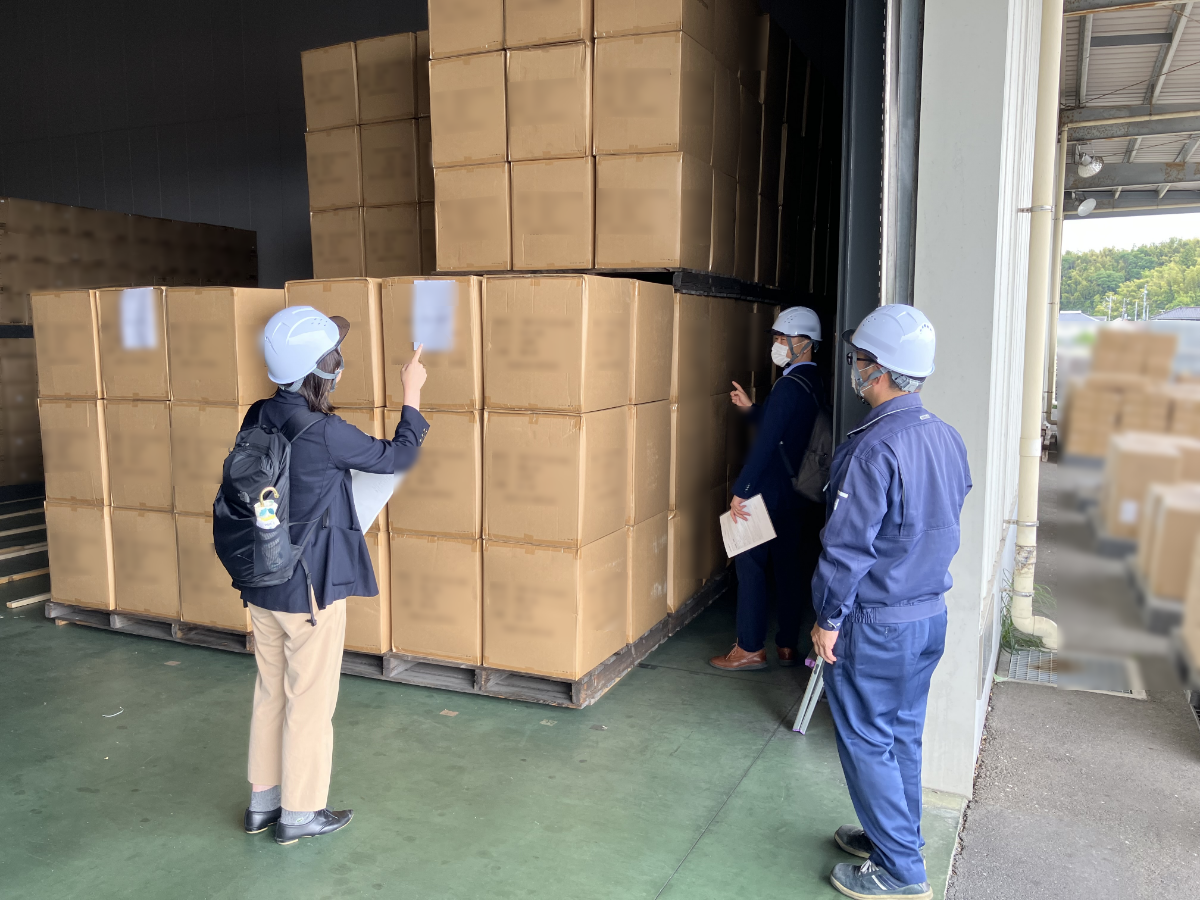
For the Inabata Group, logistics is one of the key function that complements trading activities and is an essential function for delivering added value. We manage warehouse operations in collaboration with external warehouse companies, which are important business partners, to provide high-quality inventory services.
The Group conducts regular evaluations of its contracted warehouses from multiple perspectives, including storage environment factors (such as building robustness, security systems, and appropriate segregation), IT readiness, BCP preparedness, and warehouse management practices (including safety management and outbound control).
In principle, physically count inventory are conducted at least once a year. Personnel from the relevant sales divisions visit the warehouses in person to verify not only inventory quantities but also inventory conditions and management practices, as well as licenses and permits required for inventory storage. In addition, personnel from administrative departments accompany the process as observers to confirm that physical inventory counts are conducted appropriately in accordance with internal regulations and operating manuals.
Product and Supplier Management (Food Business)
The food business in the Life Industry segment relates directly to the safety and health of consumers and is thus required to exhibit high levels of product and supplier control.
We conduct strict product and supplier control to provide safe and secure agricultural and marine products from all over the world under the motto of “from visible producers to visible consumers.” When starting transactions with a supplier, we carry out basic surveys such as interviews and audits to find out if the supplier possesses international certifications. When importing food, our procurement workflow requires confirmation that pesticide usage and residual pesticides meet Japanese standards, among other matters.
Declaration of Partnership Building
The Company the objectives of the Council on Promoting Partnership Building for Cultivating the Future, promoted by the Cabinet Office and the Small and Medium Enterprise Agency, and has published its Partnership Building Declaration.