
- Materiality Identification Process
- Inabata Group's Material Issues
- Descriptions
- Material Issues and the business segments
In June 2022, we identified material issues (materiality) for the sustainable growth of our Group.
In May 2024, we formulated the Sustainability Medium-term Plan 2026 to address these material issues.
Overview of the Sustainability Medium-term Plan 2026
| 1 | Sustainability at the Inabata Group |
| 2 | Materiality: Descriptions and Relevant Business Segments |
| 3 | Materiality: Risks, Opportunities, and Main Initiatives |
| 4 | Materiality: Long-term Vision, Strategy, KPIs, and Targets |
For details, please refer to the Sustainability Medium-term Plan 2026 page.
Materiality Identification Process
In the materiality identification process, it is essential to determine which issues are important to the Group’s growth by considering a wide range of information from multiple internal and external perspectives. To do so, we followed the process outlined below. Over the course of the process, the Sustainability Committee, where outside directors and other executives participate as observers, convened twice for lively discussions. We were also able to obtain valuable suggestions by holding stakeholder dialogues with external experts.
Step 1List social issues
A list of social issues was created with reference to international guidelines (GRI, SASB, SDGs, ISO 26000, UNGC Ten Principles, etc.) and external evaluations and requests (various ESG surveys such as FTSE Russell and MSCI, investor requests, etc.).
Step 2Extract issues and evaluate importance
The Sustainability Committee Secretariat and Sustainability Promotion members narrowed down 23 issues from the four fields of business, environment, society, and governance, and evaluated them according to the two criteria of importance to the Group and importance to stakeholders. Based on the results, issues were consolidated, descriptions were reviewed, and tentative material issues were identified. The Sustainability Committee deliberated on tentatively identified material issues.
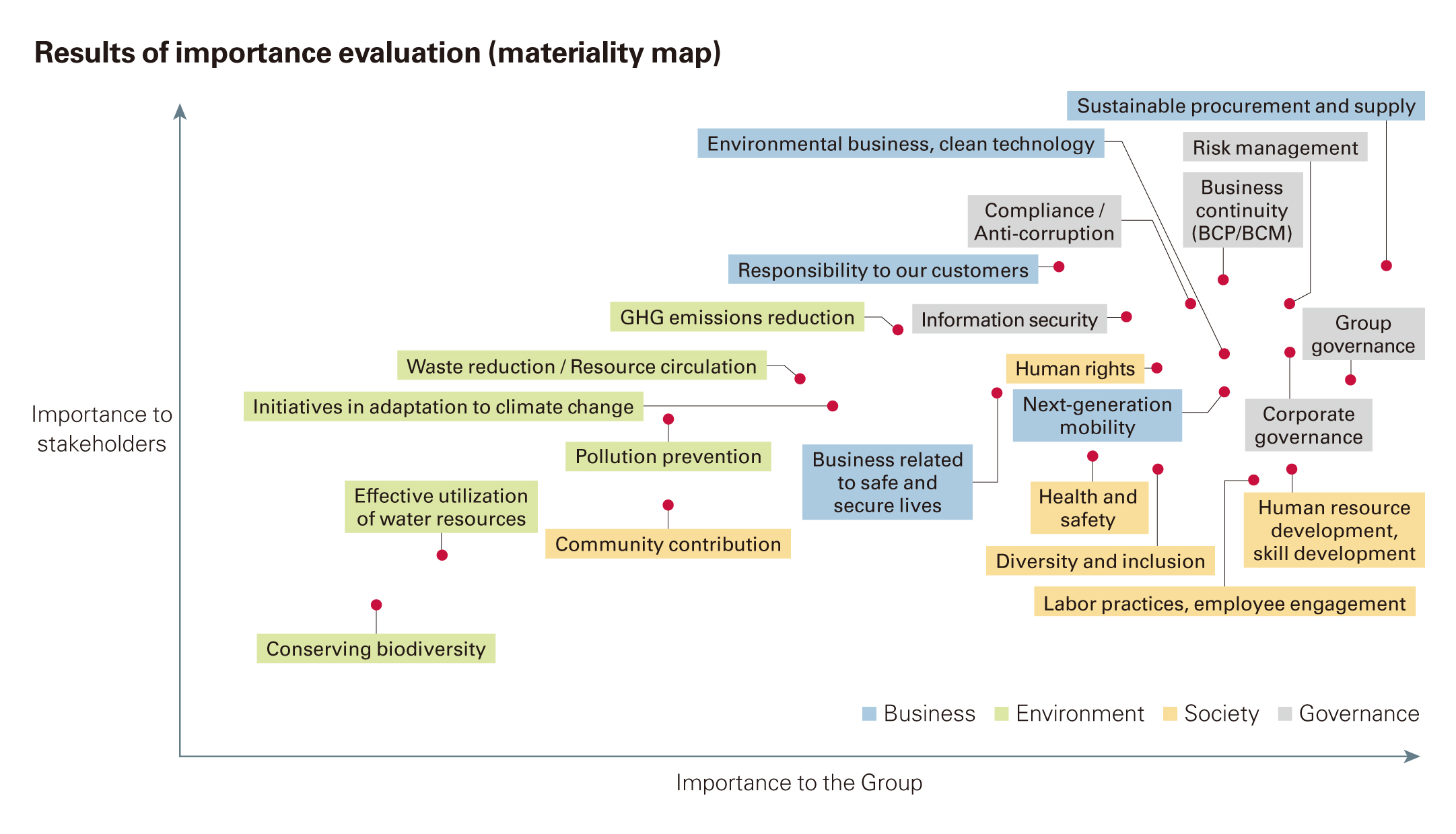
Step 3Verify validity from an external perspective
Stakeholder dialogues were held with external experts who have a broad knowledge of sustainability, the director in charge of sustainability (Director, Senior Managing Executive Officer), and the Sustainability Committee Secretariat.
Step 4Management makes decision
The Sustainability Committee discussed and decided on candidate material issues based on external opinions.
Inabata Group's Material Issues
The Group’s material issues were evaluated based on their importance from the dual perspectives of financial and non-financial impacts.
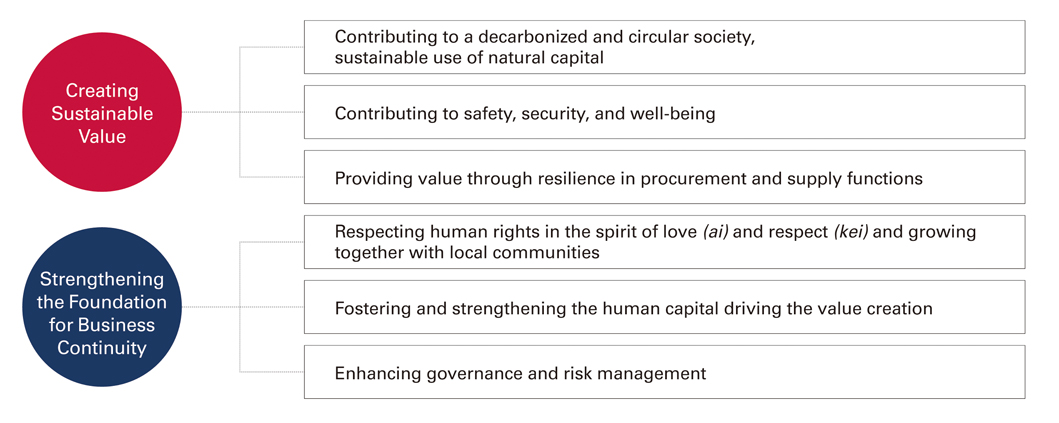
In terms of financial impacts, we expect three material issues related to “Creating sustainable value” through the provision of products and solutions to have short-term and direct impacts on the Group. Conversely, three material issues related to “Strengthening the foundation for business continuity,” which underpins our corporate activities, are anticipated to have medium- to long-term and indirect effects.
Material issues
Descriptions
| Material issues | Key points | |
|---|---|---|
| Creating Sustainable Value | Contributing to a decarbonized and circular society, sustainable use of natural capital | We will focus on environment-related businesses, such as environmental load-reducing products, in areas including renewable energy, alternative fuels, recycling, and electric vehicles to build a decarbonized and circular society. We will also promote the sustainable use of natural capital in our businesses related to building materials and food. We will take steps based on our environmental management system to reduce GHG emissions, reduce waste and increase the reuse of resources, prevent pollution, and conserve water resources and biodiversity to conserve the environment. |
| Contributing to safety, security, and well-being | We will provide solutions that contribute to safety, security, and well-being through our mobility, food, and life science businesses. Chemicals are fundamental to a wide range of industries. We will maintain a high awareness of the responsibility associated with chemical substance management, product safety, and quality. | |
| Providing value through resilience in procurement and supply functions | Providing flexible and optimal dealings is an important function of Inabata Group as a trading company. In an uncertain, unpredictable society, the functions of the Inabata Group provide even greater value as a solution provider for changing customer and social needs. We will deliver value through resilience in procurement and supply functions by strengthening our supply chain management. To achieve this, we will use our global network and leverage our multifaceted functions as a trading company, such as product development, partnerships, and logistics expertise. | |
| Strengthening the Foundation for Business Continuity | Respecting human rights in the spirit of “love (ai)” and “respect (kei)” and growing together with local communities | We respect the human rights of stakeholders associated with Inabata Group activities based on our core value of respecting people with the spirit of “love (ai)” and “respect (kei)”. We will share value with the people and to develop and grow with the local communities where we do business around the world. |
| Fostering and strengthening the human capital driving the value creation | People driving the creation of new value are the Group’s greatest asset. People trusted by our clients to become their best partners by demonstrating high ethics, passion, and providing solutions from a global perspective are the source of sustainable value creation. The resourcefulness of our employees is what enables us to continuously produce value. We believe that an organizational culture that recognizes diversity and values free and open discussions and teamwork will have high employee satisfaction and will support ongoing sustainable growth for both employees and the Company. We will continue to promote new workstyles, diversity & inclusion, employee engagement, human resource education and skill development, and occupational safety and health. | |
| Enhancing governance and risk management | We maintain a strong corporate governance system as a fundamental element of our continuous efforts to enhance corporate value. The system ensures management transparency and fairness provides a foundation for swift and decisive decision-making. We are also strengthening group governance in Japan and overseas and are fortifying our risk management, which encompasses compliance, corruption prevention, business continuity management, and information security. | |
Material issues and the business segments
For the category of material issues of “Creating Sustainable Value,” which we aim to achieve through the provision of products and solutions, we have set out the business domains where we will focus our efforts. The relationship between these domains and our business segments is as follows.
| Information & Electronics | Chemicals | Life Industry | Plastics | |||
|---|---|---|---|---|---|---|
| Creating Sustainable Value | Contributing to a decarbonized and circular society | Renewable energy | ★ | ★ | ||
| Alternative fuels | ★ | |||||
| Recycling | ★ | ★ | ★ | |||
| Electric vehicles | ★ | ★ | ★ | |||
| Sustainable use of natural capital | Building materials | ★ | ||||
| Food | ★ | |||||
| Contributing to safety, security, and well-being | Mobility | ★ | ★ | ★ | ||
| Food | ★ | ★ | ||||
| Life Science | ★ | |||||