
Dialogue Between CFO and an External Expert
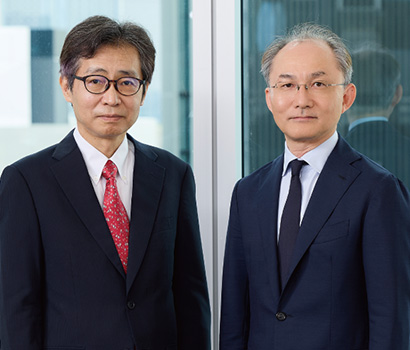
Profile of Kazuhiro Toyoda
Head of Japanese Equities, Fund Manager, Schroder Investment Management (Japan) Limited. Graduated from The University of Tokyo’s Faculty of Economics in 1990 and earned an MBA from the Graduate School of International University of Japan in 1998. Joined Schroder in April 2008. Has held his current position since September 2023. Chartered Financial Analyst (CFA) and a Certified Member Analyst of the Securities Analysts Association of Japan (CMA).
To continuously drive change and enhance corporate value over the long term
From a focus on profit and loss to the balance sheet Evaluating qualitative changes in financial strategy
Toyoda
I am focusing on the qualitative changes in financial strategy. Initially, around the launch of the medium-term management plan, New Challenge 2020, in FY2017, the approach was centered on the profit and loss statement, with a strong emphasis on sales and profit targets.
Yokota
Indeed, at that time, the focus was primarily on stabilizing and boosting earnings, and there wasn’t enough attention given to managing with an awareness of capital efficiency. By around 2020, earnings had stabilized, and corporate governance codes and similar standards had become well established among listed companies. At the Management Council and other venues, we worked to align the executives’ understanding by presenting the initiatives of the Financial Services Agency and Tokyo Stock Exchange to advance corporate governance reforms, alongside sharing the views of institutional investors. Building on that, we advanced reforms such as reducing strategically held shares, enhancing shareholder returns, and strengthening investor relations (IR).
Toyoda
I see. Given that background, New Challenge 2023, launched in FY2021, shifted its focus from a profit-and-loss-centered financial strategy to an emphasis on the balance sheet, including setting ROE targets and improving asset efficiency. In 2023, the Tokyo Stock Exchange requested measures aimed at realizing management that is conscious of the cost of capital and stock price. Notably, it explicitly specified expectations for listed companies regarding stock price and market valuations such as the P/B ratio, which clearly differed from previous notifications. I commend Inabata for swiftly shifting its management focus to these aspects as early as FY2021.
I want to gain confidence that Inabata will remain engaged in the value chain.
Yokota
In New Challenge 2026, “accelerate growth” has been adopted as a key theme. What are your expectations for Inabata during this medium-term plan period and beyond?
Toyoda
I expect to see more proactive investment and a thoughtful approach to how capital is allocated for growth—in short, a focus on wise spending. In that sense, the fact that Inabata disclosed its three-year capital allocation plan for the first time in New Challenge 2026 was highly significant, wouldn’t you agree?
Yokota
Yes, given the emphasis on growth investment while maintaining a high level of shareholder returns, we believed that disclosing our capital allocation plan was essential.
Toyoda
In the trading company business, enhancing per-employee productivity is crucial, and I’m closely watching the initiatives being implemented to achieve that.
Yokota
Enhancing productivity and establishing a foundation for sustainable growth over the medium to long term hinges on possessing the right functions to penetrate key stages of the value chain. I believe it is important to invest a portion of our capital in M&A and equity participation to develop businesses capable of partially taking over functions traditionally handled by customers or manufacturers.
Toyoda
You're absolutely right. For instance, let’s consider a business that consistently generates stable profits and has been successful. If Inabata, rather than another firm, is the trading company deeply involved in that value creation process, there must be a compelling reason for it. As an investor, I want to gain confidence that, through providing this function, the company will remain an integral part of the value chain for the long term.
Regarding the low valuation of the stock price and lack of recognition from the market
Yokota
I am also aware that there are challenges inherent to the trading company sector. Could you kindly offer any advice?
Toyoda
In the case of trading companies, there is a risk of suddenly losing trading rights, which makes it difficult for investors to forecast the top line (net sales). To address this issue, it is effective to carefully explain that the Company is firmly embedded in the value chain. I would like to see Inabata take a more proactive approach to disclosing information in this area.
Yokota
Indeed, the explanation regarding the functions I mentioned earlier may have been somewhat insufficient. Inabata is categorized as a small-cap stock based on its market capitalization. What concerns do you have about small-cap stocks in general?
Toyoda
Small-cap stocks often have insufficient resources, particularly in governance, making them vulnerable to sudden events that can abruptly erase profits. Moreover, there are instances where it is uncertain to what extent investors’ views are conveyed to the executive team.
Yokota
From that perspective, we consistently make it a priority to relay investor feedback gathered during IR meetings to the Board of Directors, and disclose this information annually under the title “Implementation Status of Dialogue with Shareholders.”
Toyoda
That’s right. From an investor’s perspective, being able to understand how their opinions have been reflected in management decisions is something they appreciate. If it is evident how the company confronts investors’ doubts and concerns and strives to make improvements, it can be inferred that significant failures are unlikely to occur.
Toyoda
Also, in equity investing, both the level and the rate of change (delta) are important factors to consider. For instance, an ROE of 10% relates to assessing the current level, while the rate of change focuses on whether it decreases from 10% to 7% or increases to 12%. The key point is the expectation of how the 10% will evolve moving forward. Inabata has steadily achieved gradual change over time, and investors are closely watching whether the company can continue to evolve as a valuable presence in society going forward.
Yokota
In order to meet those expectations, it is important not to be overly constrained by the conventional trading business framework. Regarding M&A, we are targeting fields and businesses beyond our existing channels. Acquiring the time and capabilities necessary to develop competencies internally is also essential. When selecting investment targets, we naturally place strong emphasis on profitability. To drive dynamic growth, we will pursue investments with both caution and boldness.
Toyoda
The premium assigned to the stock price reflects the quality of management. From this perspective, M&A is a highly important factor in assessing management quality. Investors evaluate the effectiveness of M&A based on past track records, so if a company can demonstrate the extent of synergies generated from previous M&A activities, it can increase investors’ conviction. I look forward to seeing Inabata continue to evolve.
Yokota
Mr. Toyoda, you have been researching and analyzing our company for many years. How do you view the recent business performance?